How Recipe Cards Carried Household Cooking Knowledge
Explore how handwritten recipe cards carried household cooking knowledge, recorded adaptations and preserved family food traditions without claiming to predate cookbooks.
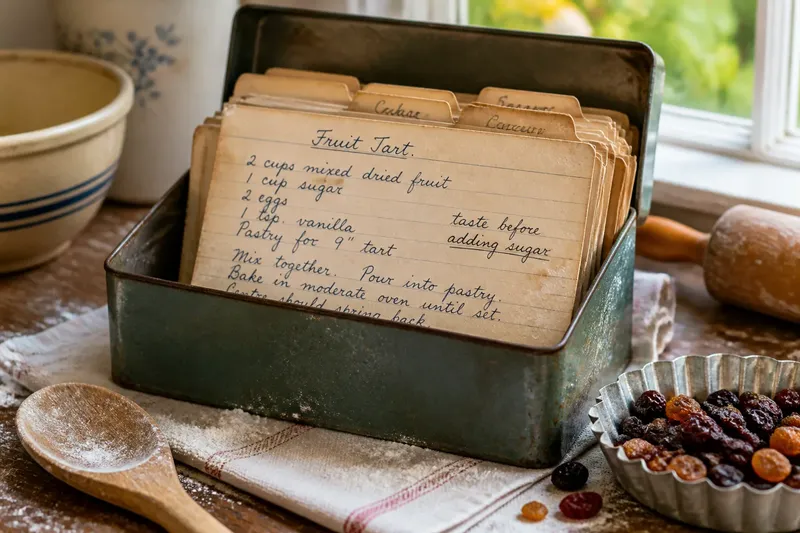
A flour-smudged card tucked into a tin may hold a dish’s ingredients, a reminder about the oven and a name written in a familiar hand. Recipe cards carried household cooking knowledge, but their relationship with printed cookbooks was not a simple matter of one coming before the other.
Handwritten recipes and printed cookbooks existed alongside many ways of learning to cook: watching, listening, remembering and copying. A card could preserve a household’s version of a dish, whether its writer learned it from another cook, adapted a printed recipe or developed it through practice.
Recipe cards and cookbooks belonged to overlapping traditions
There is no single sequence in which recipe cards replaced oral instruction and then gave way to cookbooks. Written recipes circulated in different forms, and the evidence on an individual card rarely establishes when a dish first appeared or where its wording originated.
A printed book offered recipes to readers beyond one household. A handwritten card could be more personal: it might record a preferred texture, an available ingredient or a reminder that made sense to someone who already knew the method.
For that reason, a handwritten card is not automatically older than a printed cookbook, nor does it prove that a household lacked books. It is evidence that someone chose to record or keep that version of a recipe.
Household notes made recipes usable in a particular kitchen
A card might preserve an ingredient list, but its most useful detail could be a short instruction such as “stir in after cooling” or “use the shallow dish”. Such notes connect general cooking knowledge to the equipment, ingredients and habits of a particular kitchen.
Cooking cues could matter more than exact timing. “Take it out when the centre springs back” gives a cook something observable to look for, even when the card does not explain how long the dish should bake.
Handwriting and revisions also deserve careful reading. A crossed-out ingredient shows that the wording changed; by itself, it does not explain why, or identify who made the change.
Readers can separate what a card records from what it suggests
A careful description distinguishes visible evidence from interpretation. “The card names dried fruit” reports what is written; “the cook had no access to fresh fruit” is a possible explanation that needs other evidence.
Physical clues can add context without settling a card’s history. Paper, ruled lines, printed branding or a clipped instruction may help describe how it was made, but a card could be reused or copied later.
Imagine you inherit a card with a fruit tart recipe and a handwritten addition: “taste before adding sugar”. You transcribe the original wording, mark the addition as a separate note, and ask a relative who remembers the dish whether they know when it was added. The result is a record that preserves both what the card says and what remains uncertain.
Household recipe cards preserve changes as well as instructions
Cooks often adjusted recipes to suit the ingredients, equipment or preferences at hand. Notes in a margin, between lines or on the back can show that a recipe was used and revised, rather than copied as an untouchable text.
When making a readable copy, keep the inherited wording distinct from later changes. Attribute or date a note only when that information is known; otherwise, call it an addition without guessing who wrote it.
That distinction gives a future cook room to make a choice. They can follow the original instruction, try the recorded adjustment or leave both versions intact.
Cards travelled through relationships and gathered different forms
A handwritten recipe could pass between relatives, neighbours and friends, or arrive with a dish at a gathering. Some cards name a cook; others use a family nickname or an occasion, such as “Sunday pudding”.
Collections were personal rather than uniform. A cook might arrange cards alphabetically, group them by meal or keep newspaper clippings among handwritten recipes. A copied card could also shorten or rephrase its source, so resemblance does not establish an exact transcript.
If a card has no author or date, describe what is present rather than assigning it a definite origin. An unknown author does not make the card less useful as evidence of a household’s cooking practice.
Recipe cards offer a close view of food history
A card can show which ingredients a writer named, what cooking cues they expected a reader to recognise and how a dish related to an occasion. It cannot, by itself, explain an entire family’s food habits or the history of a community.
Omissions are worth noticing. A recipe that skips a preparation method may have been written for someone who learned by watching, or it may simply be abbreviated. The missing detail is visible; its reason may not be.
Keep those two points separate when describing a card: record its exact wording and identify interpretations as possibilities. This makes the account more trustworthy without making it less interesting.
Preserving a family recipe card starts with a faithful copy
Keep the original away from spills and heat, handle fragile paper gently and avoid writing over old text. For regular cooking, use a separate working copy so new adjustments do not become confused with inherited notes.
A clear photograph and a careful transcription make the card easier to consult. Mark words you cannot read as uncertain rather than silently supplying a guess, and keep notes about family recollections separate from the card’s own text.
Before sharing a recipe, check what the copy says and decide how to handle uncertain marks:
- Ingredient wording: Observe the exact term on the card; if it is clear, transcribe it as written, but if it is ambiguous, mark it uncertain rather than substituting a modern term.
- Cooking cues: Check for colour, texture, smell or touch; if a cue is recorded, include it in the copy, but if none appears, do not invent one.
- Corrections: Observe crossed-out words and additions; if their order is clear, distinguish each in the transcription, but if it is unclear, describe the mark without assigning a sequence.
- Names and occasions: Check for a person’s name or a serving note; if it is legible, record it, but if it is not, leave the identity unresolved.
- Format and material: Observe whether the item is a handwritten card, a clipping or a copied page; if its form is clear, describe it, but if its origin is uncertain, avoid naming a source.
- Photograph quality: Check that the image shows the whole card and its writing; if details are legible, retain the image with the transcription, but if they are not, make another image in better light rather than guessing.
Questions readers ask about household recipe cards?
Does handwriting prove that a recipe predates cookbooks?
No. A handwritten card may copy a printed recipe or another person’s version, and its handwriting does not establish the recipe’s age. Describe it as a household record unless other evidence supports a more specific claim.
Why might an old card omit cooking times?
The writer may have expected the reader to recognise a visual or tactile cue, or may have left the timing unwritten for another reason. Record the omission and preserve any surviving directions about colour, firmness or texture.
Should I correct unclear wording on an inherited card?
Keep a faithful transcription and put any proposed interpretation in a separate note. That preserves the original wording while making your reading available to the next cook.
How can I share a recipe without losing its history?
Share a copy that includes visible notes and clearly separates known details from uncertain ones. Keep the original safe, and label new changes as additions rather than merging them into the inherited text.
Household recipe cards keep kitchen knowledge visible
Recipe cards matter as records of practical cooking knowledge: they preserve instructions, adjustments and clues about the way a dish was used. Their value does not depend on proving that cards came before cookbooks.
When you handle one, keep the original wording and the later marks distinguishable. A clear transcription can preserve what is readable, while an honest note about what remains unknown leaves the next cook room to learn without turning a guess into family history.